
Pathways to Decentralization
Strengthening Local People, Communities and Economies

Pathways to Decentralization
Strengthening Local People, Communities and Economies
(Note: This is a draft I have written as a proposed “going local” campaign platform for someone who may declare as an independent presidential candidate. PLEASE share your thoughts and ideas in COMMENTS. - Alanna)
For there to truly be Liberty and Justice for All, to fully realize the values of freedom and fairness, we need to directly address the issues of “land” and “money” that show two fundamental flaws of our political economy. Land and other natural resources should not be treated as commodities for speculation and profiteering but rather as the precious basis for sustaining all of life. By Natural Law the Earth is the birthright of all and needs to be both protected with care and fairly shared. Money should be viewed as a utility for the production and exchange of wealth, not as a predatory system for the profit of the few. The first two points of our Strengthening Local People, Economies and Communities present policies based on these principles.
1. Shift to land value tax, public land lease and other commons rent based public finance to curb land speculation and profiteering while removing taxes on labor and production to enable access to affordable land for housing, local owned businesses and small farm regenerative agriculture.
2. Establish non-profit public banks, full-service credit unions and alternative currencies to eliminate the predatory money system by treating money as a public utility.
3. Enable “participatory budgeting” whereby people can vote for how a significant portion of their tax dollars are spent.
4. Remove all barriers to fully enable and support local food production based on organic, regenerative agriculture.
5. Encourage local capital investment in needed goods, services and industries via 3P - people, planet, fair profit - charters.
6. Develop and maintain not-for-profit infrastructure for energy, sanitation, clean water, transportation, and other public services.
7. Establish not-for-profit insurance cooperatives that enable citizens to share information that helps to maintain and support physical and mental health.
8. Promote and encourage local culture and creativity via the arts of music, dance, writing, poetry, painting, entrepreneurship and the DIY maker movement.
9. Strengthen and enhance community connectivity, participation and mutual aid societies in order to support physical, emotional, mental and spiritual well-being.
10. View localities as embedded in bioregions on up to the global level envisioning local-to-global citizen assemblies for world peace keeping and environmental restoration and protection.
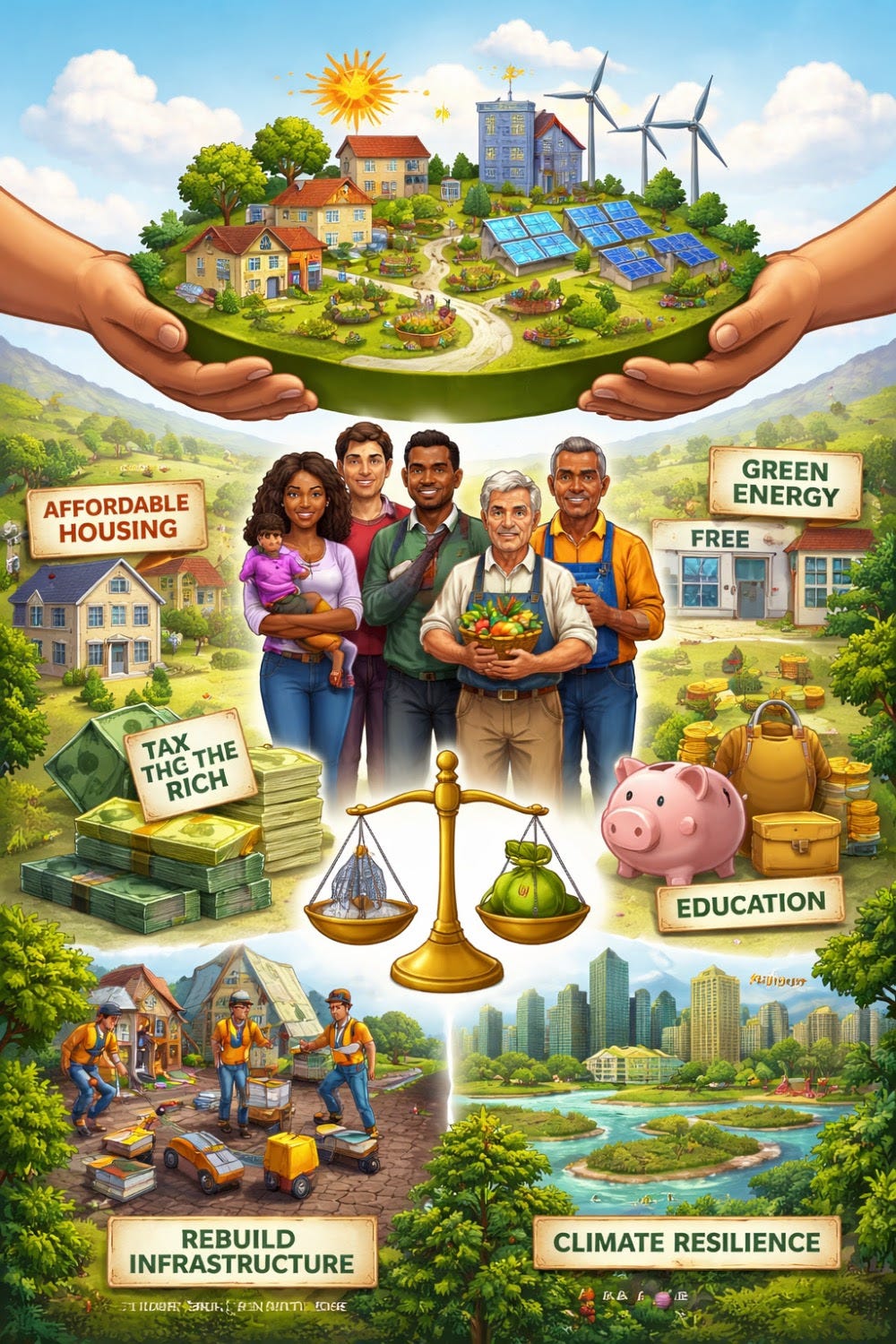
Image courtesy of Marybeth Gardam, Women’s International League for Peace and Freedom, who organized my webinar posted here:
Hi, thanks for putting this together; let's talk about it. Maybe we could do a TAP Talk, or I will bring it up for discussion tomorrow at the monthly Green Liberty meeting and discuss it in the context of advancing a liberation coalition. I would like language that speaks to building a commons of key infrastructure. I think your language is fine; it reads well and is concise. Appealing to a non-party affiliated is appropriate. Have you introduced this to Dennis K? I saw him on a Highwire , at a people versus poison rally:
https://thehighwire.com/ark-videos/bipartisan-uprising-the-people-vs-poison-rally/
When any system becomes broken, and attempts are made to repair it, the process involves several steps. If these steps are skipped or implemented incorrectly, the system will likely just break again.
A working system depends on at least three different but related factors: 1) Desire that the system work and remain working; 2) Implementation of workable technologies for the system; 3) Some sort of maintenance and defense structure for the system.
Thus, the repair of any system must include these points:
1) Did someone desire to disable the system?
2) Have the technologies of the system been changed or somehow rendered unworkable?
3) Was there a problem with the maintenance or defense of the system?
And the process of repair must include following up on each point:
1) Restraining those who wish to harm the system.
2) Restoring the technologies of the system.
3) Restoring the structure that maintained and protected the system.
In this particular case, which has to do with the undue concentration of wealth and power in too few hands, the ethical element (1) is extremely important and often left out of the discussion.
We are talking about the implementation and protection of an economic system that will be fair and broadly workable and acceptable, so that the lives of many are improved.
It is not clear to me that - in the absence of criminal intent - such a system would not tend to "create and maintain itself" so to speak. We have seen a few cases historically where this seemed to happen. The focus, then, I believe, should be on the eradication or at least restraint of criminal intent to harm any such system or render it unworkable by altering is technologies or undermining its protective structures.
Too many reformers think that the problem lies in our poor choice of technologies. That if we would just implement certain patterns and rules, that everything would start working better. While some may have a valid argument, if they don't first deal with the ethical problems that threaten any such system, then their proposals will either be rebuffed or reversed over time.
The basic problem of modern life is the same basic problem that affected ancient life: Criminal Intent. This could also be described as a destructive - or even self-destructive - irrational impulse. It has been observed on several levels; most of us are only dimly aware of any of them:
1) Personal psychology. Many of us suffer from weaknesses in our personalities that hinder us in important ways. These include especially addictions and lapses of courage.
2) Criminal human groups. The psychopathic personality is commonly at the center of the various group operations that are destructive of life in various ways. This is a huge problem on Earth.
3) Off-world suppression. This influence is almost totally hidden from most of us, though it is referred to obliquely in many ancient texts, as well as some more modern ones. Our suppressors have certain technologies that allow them to hide their influence from us, making it appear as "voices in our heads" or our own ideas. They push political leaders into wars and other crimes, and business leaders into criminal practices.
We must learn to deal with all of the above ethical problems if we want life on Earth to smooth out a bit and become more livable and widely beneficial. The world is full of good ideas, such as those propounded by Henry George. But it is also full of criminals who don't want things to go well here. The good ideas will not survive unless the criminal intentions are brought under our control.